Camco 40064 Water Pressure Regulator with Gauge Guide
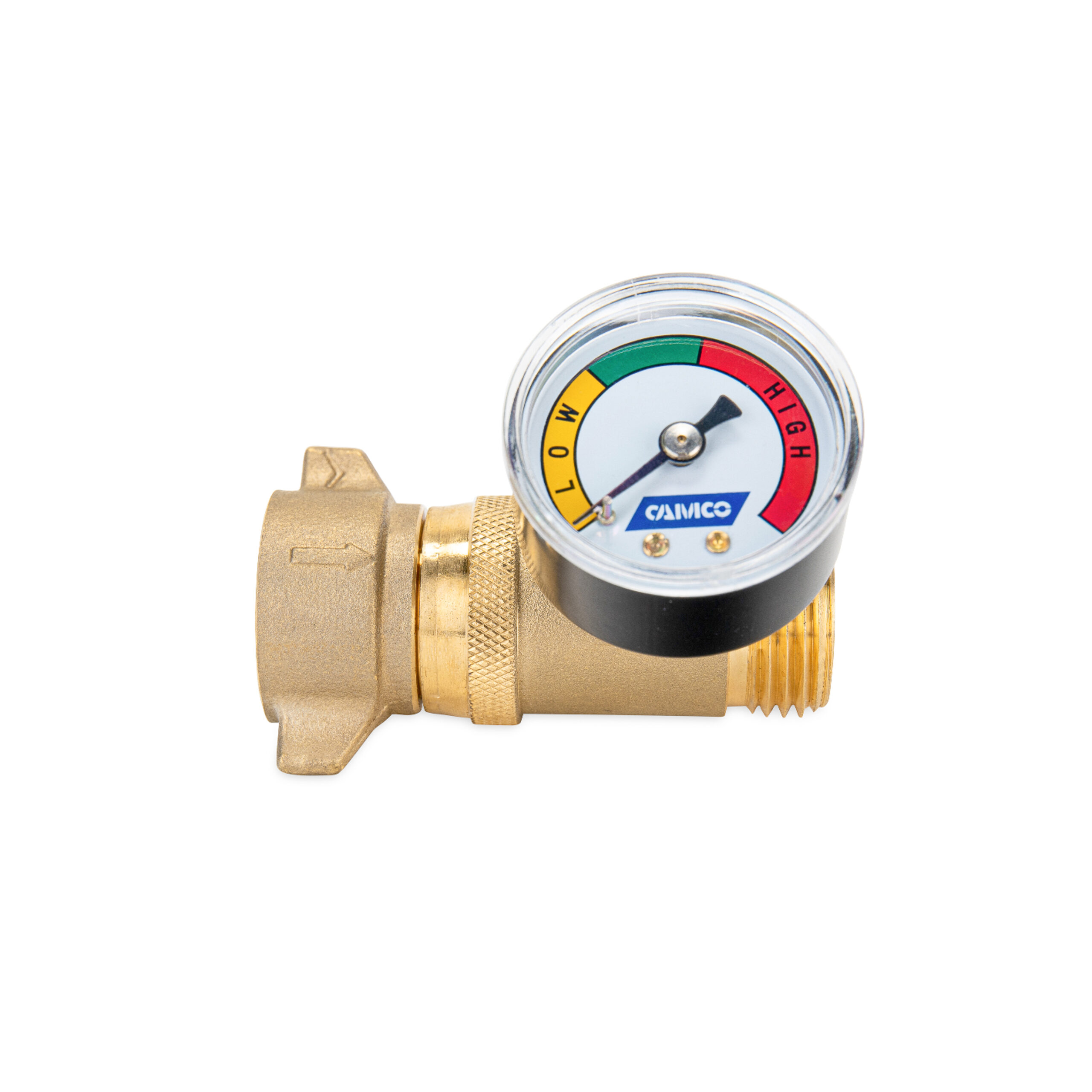
Exact product shown: Camco 40064 Water Pressure Regulator with Gauge Guide. Manufacturer photograph used with permission.
The Camco 40064 regulator combines a fixed-pressure approach with a visible gauge. That makes it a useful candidate for RV owners who want to observe their hookup without choosing an adjustable model. The key is understanding what the dial can tell you and what it cannot establish about the rest of the water system.
We have not measured this product’s accuracy, flow loss or long-term durability. This buying guide uses Camco’s exact-model documentation and practical installation considerations. It treats the gauge as an instrument to interpret, rather than proof that every hose, filter and fixture downstream is operating under ideal conditions.
Verify model 40064 before comparing features
Camco’s dealer information identifies 40064 as a brass regulator with a color-coded pressure gauge and a factory preset of 40 to 50 PSI. The same description lists a maximum incoming pressure of 125 PSI, three-quarter-inch garden-hose attachment and outdoor use. Confirm those requirements on the supplied product before installation.
This model is not the same as the Camco 40058 adjustable regulator. A listing that groups both products into selectable variations can make the distinction easy to miss. Match the number on the selected variation, the package photograph and the written description before assuming you can change the setting.
Camco also describes drinking-water suitability and lead-content compliance. Those are manufacturer statements about the product and materials. They do not mean the device filters lead from the supply, disinfects water or replaces the need to verify that a campground faucet is potable.
When the integrated gauge is useful
The dial gives you a convenient observation point during setup. An owner who has experienced inconsistent campground pressure may prefer seeing a reading rather than relying entirely on a fixed regulator with no display. It can also help describe a problem to a service technician with more precision than “the water seems weak.”
However, a gauge is useful only in context. Know which side of the regulating mechanism and which part of your hookup it represents. Also record whether any taps were open when you read it. Two numbers taken under different operating conditions are poor evidence for comparing products or diagnosing a fault.
For instance, you may see one reading with all taps closed and a different reading while the shower runs. A pressure drop during use does not by itself establish a defective regulator. The water source, hose diameter, kinked connections and filter restriction can all affect delivered flow through the assembled system.
Decide whether a preset range fits your RV
Read the RV’s city-water instructions before buying. If its permitted pressure is lower than the range documented for this device, select a compatible regulating solution instead of assuming the dial changes the preset. The rating of the weakest relevant downstream component also matters, including a filter housing added by a previous owner.
An integrated gauge does not remove the need for this compatibility check. Its colored zones are a visual aid on the product, not an individualized pressure recommendation for your motorhome or trailer. Your manual and equipment instructions remain the starting point for deciding whether the model fits.
If you need a lower or deliberately adjustable setting, compare the 40064 with an actual adjustable design. Keep that decision separate from a desire for more shower pressure. A regulator cannot create additional pressure when the campground supply is already insufficient, and raising a setting beyond an equipment limit is not a remedy for a restricted cartridge.
Measure clearance for the gauge and fittings
Compared with a plain inline regulator, the dial creates another shape to accommodate around the faucet or utility compartment. Check access for your hand, the hose swivel and any adjacent connection. You should be able to read the gauge and disconnect the equipment without twisting the RV inlet or using the dial as a handle.
Look at the whole planned assembly. An elbow, hose protector, quick connector and filter can change the load on the attachment point. The practical concern is not only whether the pieces screw together, but whether they sit naturally without strain or an awkward bend when the compartment door is closed.
Garden-hose threads should not be confused with similarly described pipe threads. Verify adapters by connection type and sealing method. Inspect the relevant washer and use the manufacturer’s tightening instructions instead of adding tape indiscriminately or forcing a connection that begins to cross-thread.
Set up so the reading remains meaningful
Use the approved connection sequence for the RV and all accessories. The placement should protect the components that require regulated pressure. Keep the dial visible and the source shutoff reachable so you can respond promptly if a leak or unexpected reading appears.
Open the water supply with supervision after connecting. Look for water at the regulator joints and the gauge connection without touching or adjusting pressurized parts. If the setup leaks, shut the source off, relieve pressure and correct the actual sealing problem before continuing.
Then compare fixture behavior in a repeatable way. Note which faucet was open and whether a filter was present. If you change several components and settings simultaneously, a better shower will not tell you which change mattered. A short written record makes later troubleshooting much more useful.
Protect the gauge during ownership
A dial should remain readable and physically sound. If the lens becomes obscured, damaged or difficult to interpret, do not invent a reading from the needle’s approximate position. Get the equipment checked or replaced using the manufacturer’s guidance.
Store the assembly so the gauge is not carrying the weight of other gear. Follow draining and freeze-storage instructions rather than assuming a brass body means the whole product is immune to freezing damage. Keep grit away from connections and inspect washers before returning the regulator to service.
If you question the dial’s accuracy, a controlled comparison with a suitable reference instrument is more informative than guessing from faucet strength. Ask the manufacturer or a qualified technician about an appropriate test. Do not open the gauge or alter the regulator to make the displayed number match an expectation.
Compare the 40064 with realistic alternatives
Choose the plain Camco 40055 when a compatible fixed-pressure device and compact storage are sufficient, and you do not need an integrated display. Choose the 40064 when its stated range fits and a visible gauge is worth the additional space and care.
Consider an adjustable regulator when your actual requirements call for a selectable setting. The Valterra A01-1117VP and Watts LFH560G offer different designs and documentation to investigate. Their adjustability does not automatically make them better for an owner who already has a compatible preset arrangement.
The strongest reason to buy the 40064 is convenient pressure observation in a properly matched hookup. The weakest reason is expecting the gauge to solve every flow problem or guarantee that the water system cannot leak.
Questions before ordering
Does a gauge make the regulator adjustable?
No. Read the exact model specification. Camco identifies this product with a preset range; a separate adjustable model exists in its range.
Can I compare my gauge with a neighbor’s reading?
Only with care. Different source branches, gauge positions, filters and open fixtures can produce different observations. Record the conditions instead of treating the larger number as the better setup.
Does the inlet rating authorize that pressure inside the RV?
No. The regulator’s permitted incoming pressure and the RV’s downstream operating limit describe different parts of the system. Match both requirements before use.
Sources and verification
Research and specifications checked November 25, 2026. Verify current model details, availability and instructions before purchase.