How to Choose an RV Water Filtration System
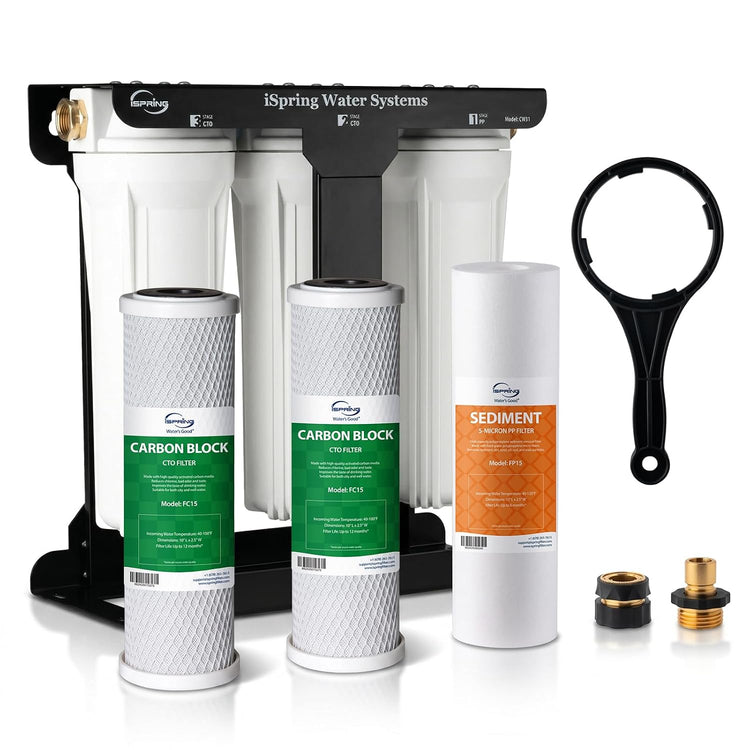
Product example: iSpring CW31 3-Stage RV Water Filter. Manufacturer photograph used with permission.
Choosing an RV water filter begins with the water problem. Sediment, chlorine taste, hardness and a known health-related contaminant require different evidence. A larger housing or a higher stage count does not make a system universally safer.
This guide is designed for RV owners who want a repeatable decision process, not a list of universal settings or a promise that one accessory fits every rig. Water systems vary by manufacturer, model year and later modifications. Use the current manuals for the RV and every installed appliance as the controlling instructions.
The examples below identify real products so readers can see how specifications change a decision. They are not claims of personal testing. Manufacturer statements, independent standards and customer feedback should remain separate. Prices, availability and seller details also change, so verify the selected offer at the time of purchase.
Identify the source-water concern
Start with a current water report, campground notice or a clearly described taste and sediment problem. Known potable campground water with chlorine taste presents a different decision from an advisory or an unidentified source.
Write the concern in one sentence, then look for documentation tied to that exact reduction. Follow the responsible water authority during an advisory and do not treat a portable filter as permission to ignore it.
A filter can improve one characteristic while doing nothing for another. Clear-looking water is not proof of microbiological safety, and improved taste does not establish hardness or lead reduction.
Product example: The iSpring CW31 uses a sediment cartridge followed by two carbon blocks, which makes it relevant to particulate and taste concerns but not a universal answer to every contaminant.
Read certification claims correctly
Standards language can be compressed in marketing until materials compliance sounds like complete-system performance. NSF/ANSI 42 and 53 address different claim categories, and a certification still applies only to listed models and reductions.
Search the certifier database or obtain the performance sheet. Match the model, cartridge and claimed contaminant. Keep a copy with the buying notes.
A component made from drinking-water-safe material is not automatically certified to reduce a health-related contaminant. Do not transfer evidence from a different system in the same brand.
Product example: GoBluTech describes drinking-water-safe materials for the AR3. A buyer who needs a particular reduction should still request exact finished-system performance documentation.
Compare flow at the right conditions
A gallons-per-minute number depends on pressure, clean cartridges and test configuration. The campground source, regulator, hose and RV plumbing can reduce delivered flow.
Compare figures only when conditions are stated. Keep the regulator within the RV’s limit and ask for a pressure-flow curve when shower performance is a deciding factor.
Never raise pressure beyond the RV’s approved limit to reproduce a marketing number. Static gauge pressure with every fixture closed does not describe flow during use.
Product example: Waterdrop lists the WD-RVS at 0.5 GPM, which makes its flow specification a central compatibility question before treating it as a whole-RV option.
Measure installation and service space
A filter can fit while assembled yet lack clearance for cartridge removal. External systems also need stable support and storage during travel.
Measure height, width, connection clearance and the space required for a housing wrench. Draw the complete hose path and plan where wet equipment will drain and dry.
Do not suspend a heavy canister assembly from the RV inlet or create a long unsupported chain of adapters. Follow temperature and freeze-storage limits.
Product example: A compact AR3 can suit limited storage, while a full-size Clearsource Ultra requires a different carrying and service plan.
Price replacement ownership, not only the system
The original purchase is only part of the cost. Replacement sets differ by size, media and system generation.
Record cartridge codes, replacement intervals and current pack prices. Use a range for annual cost when actual water quality and gallons are unknown.
A physically similar cartridge is not necessarily an equivalent substitute. Do not calculate a precise cost per gallon from an ideal capacity claim without knowing the source-water conditions.
Product example: The iSpring F3CTO belongs with compatible three-stage housings, while the Clearsource Ultra pack and Ultra Mini parts are distinct.
Related RV Water Fix guides
Use the first related guide for the next decision and the second related guide for a complementary checklist. Internal links should help a reader continue the same task, not merely repeat keywords.
Use the guide as a decision worksheet
Turn the recommendations into a short worksheet before buying or changing anything. Write the RV make, model year, water-panel type and the model numbers of the pump, heater and filter. Add the permitted pressure, available service space and the connection type you can verify from the manuals. Leave an item blank when it is unknown instead of filling the gap with a common assumption.
Next, describe the actual problem in observable terms. Examples include sediment collecting in a clear bowl, chlorine taste from known potable water, a pump that continues after every fixture is closed or a hose that cannot reach without a tight bend. This description is more useful than beginning with the name of a product. It also creates a baseline for checking whether a change helped.
Compare no more than a few compatible options at one time. Use the same fields for each: exact model, verified function, operating limits, included parts, maintenance, warranty path and total cost. Mark claims that come only from marketing and claims supported by a manual or independent listing. A blank evidence column is a reason to ask a question, not a reason to invent an answer.
After installation, review the worksheet against the observed result. Confirm that leaks, flow, noise and controls behave normally. Keep the removed part until the replacement has been verified when practical. If the expected improvement does not occur, return to the original symptom and diagnose the complete system instead of adding another accessory at random.
Build a simple ownership record
Save the model numbers, manual links and installation photographs for the components in the final setup. Record filter cartridge dates, normal regulator settings, pump circuit details and seasonal valve positions where they apply. A one-page record is valuable when another person connects the RV or when a problem occurs months after installation.
Update the record after any plumbing or appliance change. A replacement water heater, pump or utility panel can make an old procedure inaccurate even when the outside labels look familiar. When documents conflict, ask the manufacturer or a qualified RV technician instead of choosing the instruction that is easiest to follow.
How RV Water Fix evaluates recommendations
A responsible recommendation should solve a defined problem, fit the documented limits and have a maintenance routine the owner can follow. Popularity alone is not enough. A high review count does not verify contaminant reduction, pressure compatibility, electrical suitability or freeze protection. Reviews are most useful for identifying questions about fit, package contents, leakage and long-term ownership.
The best choice is often the least complicated setup that meets the documented need. Extra stages, gauges, adapters and valves add service points. They are worthwhile only when their specific benefit justifies the added maintenance. If a key specification cannot be verified, label the gap rather than guessing.
Final pre-purchase checklist
Before ordering equipment, confirm the exact model and selected variant, current package contents, connection type, operating limits, required accessories, service clearance and return policy. Compare total ownership cost, including replacement filters, seals, adapters, mounting hardware and professional work. Keep potable-water equipment separate from waste-service gear.
Before turning water or power back on, perform the model-specific commissioning steps and remain present to check for leaks or abnormal operation. Stop if the system behaves outside its instructions. This careful process is slower than copying a generic checklist, but it produces a safer and more defensible result.
Sources and verification
Research and specifications checked November 25, 2026. Verify current model details, availability and instructions before purchase.