
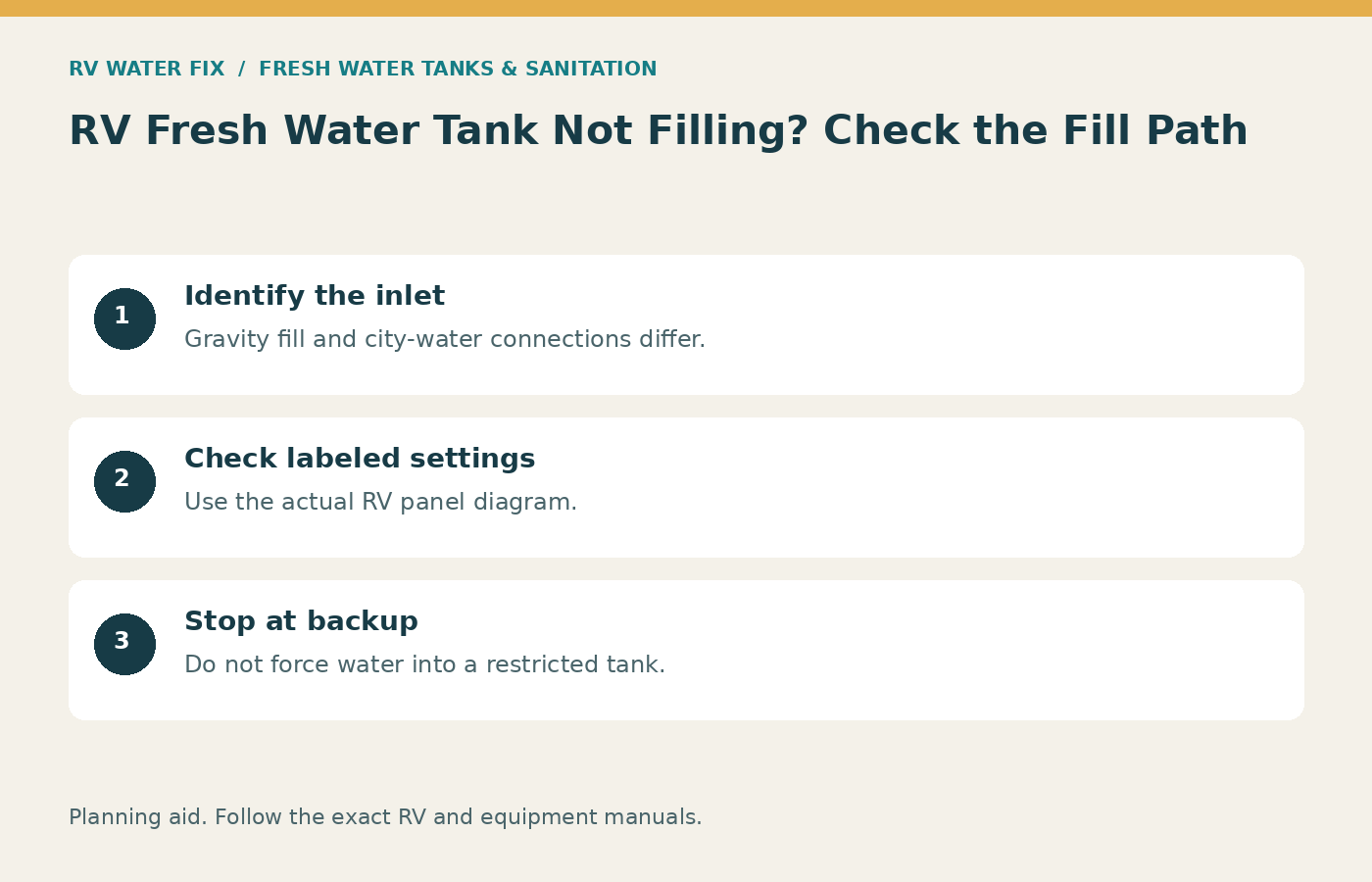
An RV fresh water tank not filling may have the wrong inlet selected, an incorrect panel setting or a restricted fill path. First identify how your RV is designed to fill. Connecting to city water does not always send water into the storage tank.
First, stay beside the RV while filling. Water backing out of a fill opening is a reason to stop and investigate, not a reason to increase pressure or seal the hose more tightly into the opening.
RV fresh water tank not filling: identify the system
First, read the labels and owner manual before connecting a hose. A gravity fill, city-water inlet and tank-flush connection have different purposes. Use only the intended potable-water inlet and dedicated clean equipment.
Some RVs route water into the tank through a selector at the utility panel. Others have a separate gravity opening. The Winnebago manuals cited below show examples of these different arrangements. Your model’s diagram determines the correct setup.
Next, photograph the panel before making changes. Confirm that the fresh-tank drain is in the required position and that no winterization setting is diverting the fill path. Change only valves you can identify.
RV fresh water tank not filling or a gauge issue?
First of all, note the starting tank reading and recent use. In addition, watch the fill behavior and any normal level indication the RV provides. However, do not rely on an erratic gauge as the only signal, and do not keep filling indefinitely to make the display change.
If water is leaving through a drain, stop the supply and verify that path against the manual. If water immediately backs out at a gravity opening, inspect the visible hose position and flow rate before assuming a hidden fault.
Avoid pushing a hose deeply into the filler. Do not make an airtight connection to a gravity tank or defeat its venting arrangement. A storage tank should not be treated like a pressure vessel.
RV fresh water tank not filling: visible checks
Next, look for a kinked external hose, debris at the opening or a visible displaced fill line. Check only areas the manual allows you to access. Do not probe into a tank or vent with wire, chemicals or compressed air.
Venting requirements depend on the RV. If the system cannot release displaced air normally, increasing water pressure can make the situation worse. Stop and ask for service when the permitted external checks do not explain the problem.
Also record whether the symptom began after storage, maintenance or a recent modification. That history can help a technician identify a changed valve setting or damaged line without unnecessary disassembly.
Fill with supervision after correcting the setup
Therefore, use the approved flow and filling method. Observe the tank indication and the manual’s full-tank signal. Stop the supply promptly at the stated point, then restore the normal-use valve setting if required.
Then inspect the compartment and ground for unexpected leakage. Water emerging somewhere other than the documented overflow deserves investigation. Do not assume every puddle during filling is normal overflow.
If the tank still will not fill, provide the shop with photos, inlet type, panel settings and a description of where water appears. Avoid repeatedly forcing water through the system while waiting for repair.
Questions owners ask
Why do faucets work but the tank stays empty?
The city-water path may supply fixtures directly while bypassing the tank. Check the specific filling instructions rather than assuming normal faucet flow means the tank is filling.
Should I remove the vent screen?
Do not modify the vent based on this symptom alone. Use the manufacturer’s inspection instructions and preserve protection against contamination. A blocked or damaged concealed vent is a service issue.
Sources and editorial notes
Source check: November 25, 2026. This is a research-based guide, not a hands-on product test or a claim of certified technician review. Manufacturer instructions for the exact installed equipment take priority. Featured artwork is an AI-generated editorial illustration, not a product photograph or installation diagram.
- 2026 Winnebago View operator manual, plumbing section
- 2025 Winnebago Towables owner manual, plumbing section
- Winnebago operator manuals by model and year