iSpring CW31 3-Stage RV Water Filter Guide
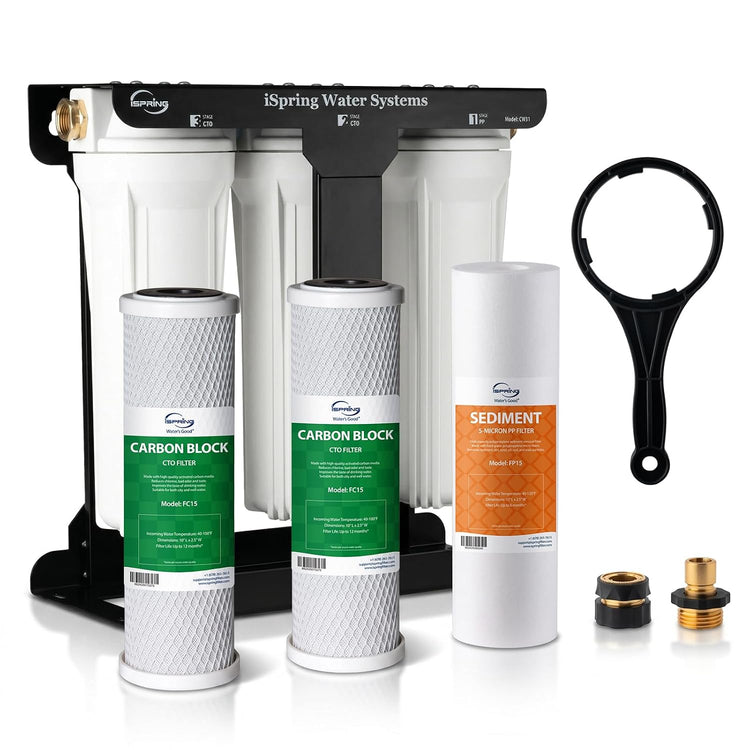
Exact product shown: iSpring CW31 3-Stage RV Water Filter Guide. Manufacturer photograph used with permission.
The iSpring CW31 is worth considering when you want separate sediment filtration and two carbon-block stages in a reusable housing system. Its strongest practical attraction is the ability to service individual cartridges instead of discarding an entire inline filter. However, compatibility with your RV’s permitted water pressure deserves attention before its stage count or appearance influences the purchase.
This guide evaluates the ordinary CW31 described on iSpring’s product page. It does not transfer features from the CW31-PFBV or another similarly named upgrade. The guidance is based on documentation and purchasing considerations, rather than a hands-on test or a claim that we measured contaminant reduction.
Understand the three stages
iSpring describes a sediment first stage followed by two CTO carbon blocks. The first stage is intended to intercept particles larger than its stated five-micron rating, while the carbon stages address taste, odor and chlorine-related concerns. That arrangement gives you three replaceable service positions, but it should not be interpreted as three different independent guarantees of drinking-water safety.
Ask what problem you actually need to address. If the campground provides known potable water and your concern is an unpleasant chlorine taste, carbon filtration may be relevant. If a water report identifies a particular health-related contaminant, you need evidence for that exact reduction. A larger assembly does not, by itself, answer that question. Our RV filtration selection guide explains how to organize that comparison.
Check pressure compatibility before purchasing
The CW31 manufacturer’s FAQ states an operating-pressure requirement of 45–70 psi. Treat this as a compatibility check, not an instruction to turn your RV regulator up. Your RV, hose and other connected equipment have their own limits, and the filter must work within the complete installation’s approved conditions.
For example, if your RV instructions call for a regulator setting below the filter’s stated minimum, do not assume that increasing pressure is acceptable. Contact iSpring and the RV manufacturer for clarification, or consider a system whose documented operating range fits your rig. Resolve the conflict before ordering rather than discovering it after arranging hoses and storage space.
Also distinguish pressure from delivered flow. A static gauge reading with every faucet closed cannot establish shower performance through the assembled hookup. The product FAQ uses broad language about not restricting flow; we have not verified a model-specific flow curve under your intended conditions. Ask for the relevant performance information when flow is a major buying concern.
Plan where the system will live
Think about installation, cartridge changes and travel as separate tasks. A space that accommodates the assembled housings may not allow enough room to remove them for servicing. Measure the intended location, check the manufacturer’s current dimensions and allow access for the housing wrench and the supported water connections.
The manufacturer identifies three-quarter-inch GHT quick-connectors at both ends. Confirm that the exact package includes the fittings your setup needs. Garden-hose threads are different from other plumbing connections that may look similar in an RV compartment. Avoid assembling an unsupported stack of adapters simply to make the system fit a cramped location.
Consider the travel routine too. Will you disconnect and store the equipment every morning, or leave it in a fixed seasonal-site arrangement? Keep serviceable components accessible, protect housings from impacts and follow the instructions for temperature exposure. An attractive permanent location is less useful if checking for a leak requires unloading the entire storage bay.
Use the correct replacement cartridges
The manufacturer’s FAQ names FP15 sediment and FC15 carbon cartridges. It describes different suggested replacement ranges for those media, with actual timing dependent on use and feed-water quality. Do not replace that information with a universal annual schedule or assume all three cartridges become exhausted at the same moment.
Before purchase, confirm the exact contents and compatibility of the iSpring F3CTO replacement set. Record the part numbers rather than relying only on a photograph of three white cartridges. A physically similar replacement may have a different treatment claim, specification or service requirement.
A useful maintenance record includes installation date, source-water conditions, trips taken and changes in performance. You do not need to invent an exact gallon estimate when no meter is installed. An honest usage record is more useful than a precise-looking figure that cannot be supported.
Setup and first-use checks
Start with the supplied instructions for your actual unit and the RV’s approved hookup procedure. Keep the source off while assembling connections, observe the marked flow direction and support the unit so hoses do not pull against fittings. Introduce water under supervision and inspect the entire assembly before leaving it connected.
Follow the prescribed initial flushing instructions rather than treating the first clear-looking water as proof that startup is complete. Likewise, shut off the source and relieve pressure before opening a housing. Do not improvise a housing-cleaning solution or expose the cartridges to tank-sanitizing chemicals without explicit manufacturer approval.
The campground water setup guide is useful for the wider connection sequence. The CW31 documentation controls filter-specific steps, while the RV manual controls the vehicle’s own valves and appliances. Keep the water heater disabled whenever its filling status is uncertain during maintenance.
Storage needs are part of ownership
iSpring’s current FAQ describes removing the filters, letting them dry and storing the filters and canisters in a clean place between camping trips. Follow the instructions supplied with your cartridge revision if they differ. Do not substitute another brand’s refrigerated wet-storage advice simply because both products contain carbon.
Clean storage also means protecting the connection surfaces from sewer equipment, dirty tools and loose debris. Label removed cartridges so their original positions remain clear. If a housing or cartridge may have frozen, obtain the manufacturer’s replacement guidance before putting it back into drinking-water service.
Alternatives and the best-fit buyer
Compare the CW31 with the iSpring CW21 when considering whether the additional carbon position justifies the extra cartridge and housing. Compare it with a disposable inline unit when daily setup simplicity and minimal storage are more important than individual cartridge servicing. For compact multi-stage alternatives, compare documented dimensions and complete replacement-pack costs, not stage count alone.
The CW31 makes most sense for an owner willing to maintain a canister system, who has suitable space and can verify pressure compatibility. It is a weaker fit when the intended treatment concern has no documented reduction evidence, the rig’s limits conflict with the published operating range, or maintaining three cartridges is more work than the owner wants.
Questions to settle before ordering
Does the CW31 soften hard water?
Do not choose this sediment-and-carbon arrangement as a substitute for documented hardness treatment. If scale is the problem, obtain hardness information and compare a suitable softening approach separately. A better taste does not establish that hardness minerals have been removed.
Is the current Amazon offer the same system?
Check the exact model suffix, included cartridges and connector package. Do not assume an offer with a similar CW31 title includes the same treatment stages as an upgraded variant. Prices and availability can change, so use the seller’s current listing for the purchasing decision.
What should the final decision depend on?
Confirm the water concern, pressure compatibility, maintenance access and replacement supply first. Then compare total ownership effort. That produces a more defensible choice than selecting whichever system has the most housings or the strongest marketing headline.
Sources and verification
Research and specifications checked November 25, 2026. Verify current model details, availability and instructions before purchase.