Waterdrop WD-RVS Inline RV Water Filter Guide
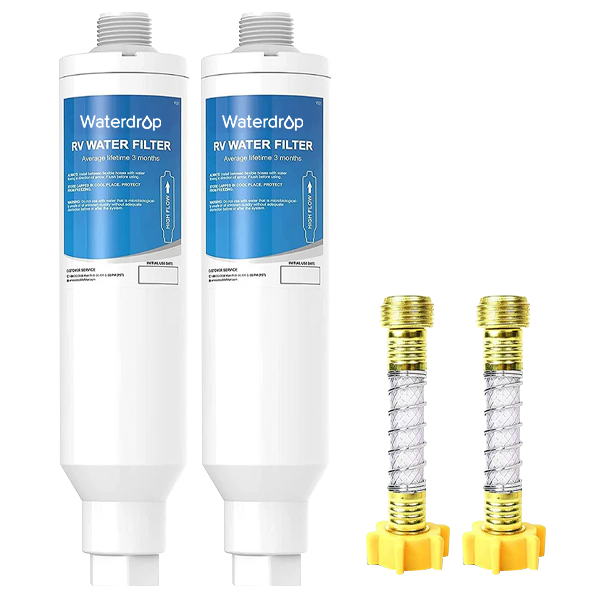
Exact product shown: Waterdrop WD-RVS Inline RV Water Filter Guide. Manufacturer photograph used with permission.
The Waterdrop WD-RVS is an inline RV filter package offered in several pack quantities, with a flexible hose protector associated with the system. Its compact format is easy to understand, but one specification deserves particular attention: Waterdrop’s FAQ lists a flow figure of 0.5 gallons per minute. Before recommending it for a whole-RV hookup, establish whether the product’s documented performance fits the way you expect to use water.
This guide is based on the manufacturer’s product information and an analysis of purchase and maintenance requirements. We have not tested the WD-RVS, measured its pressure loss or independently verified every marketing claim. It should be evaluated as a specific model, not as a stand-in for all Waterdrop filters or every item advertised as an RV inline filter.
Separate the system from the replacement
The manufacturer identifies WD-RVS as the system and WD-RV as the replacement model. Its current product data also distinguishes single-, two- and four-pack offers. Check the exact selected quantity, included hose protector and model suffix before comparing prices across sellers.
A package photograph showing several filters can make an offer look more comprehensive than a single-unit comparison. Work out what you are actually receiving and whether replacement units include the accessory you need. Keep the selected configuration consistent across photographs, specifications and the purchase link.
For a reader starting from scratch, the drinking-water hose guide is useful alongside this filter. A suitable hose and a filter are separate purchasing decisions; an inline filter does not turn an unidentified garden hose into a documented drinking-water hose.
Make the flow figure a buying question
Waterdrop’s FAQ states a rate of 0.5 gallons per minute, also expressed as 1.9 liters per minute. That is the figure to clarify with the manufacturer if your goal is supplying showers and multiple RV fixtures. Do not replace it with a larger number from another Waterdrop product or assume the same performance as a different inline filter.
Ask for the test conditions and the current manual’s guidance for the exact WD-RVS unit. The webpage’s specification does not establish what every RV will receive at its taps. Campground supply, pressure regulation, hose length, connections and internal plumbing all contribute to the final result.
If a listing promises unrestricted whole-RV flow while the manufacturer’s FAQ provides this lower figure, resolve the discrepancy before purchasing. A clear answer about the intended application is more useful than repeating whichever number makes the product look more attractive.
Match pressure and temperature limits
The manufacturer’s specifications list an operating-pressure range of 20–100 psi and an operating-temperature range of 41–100°F. The upper pressure figure is a product limit, not a recommended RV regulator setting. Your RV and other connected components can have lower limits that still control the installation.
Similarly, the lower temperature figure should not be translated into a promise of freeze protection. Keep the equipment within the manufacturer’s conditions and follow its storage instructions. Do not assume a heated hose protects every component attached downstream, or that a protected-looking compartment remained warm enough throughout the night.
The page identifies three-quarter-inch garden-hose compatibility. Confirm the actual connection ends and the approved direction of flow. Support the assembly rather than leaving the filter and accessories pulling sideways on an RV fitting.
Understand the treatment claims
The product information describes filtration media and a twenty-micron rating. It also describes chlorine, taste and odor reduction, alongside broader chemical claims. A manufacturer’s list of substances should not be rewritten as independently proven protection from every listed hazard without the exact supporting performance documentation.
The page refers to NSF/ANSI 42 chlorine reduction. Verify the relevant listing and model if that claim is important to the buying decision. A chlorine-reduction claim does not establish removal of every metal, microorganism or chemical, and a materials or burst-pressure test answers a different question from contaminant reduction.
Avoid repeating absolute marketing language about zero leakage or guaranteed drinking-water safety. Equipment can be useful without those promises. The RV filtration buying guide explains why water concerns should be identified before comparing treatment claims.
Follow the replacement rule, not a vague season
Waterdrop’s FAQ directs replacement at three months or 1,350 gallons, whichever comes first, with lifespan dependent on the source water. “Lasts a camping season” is less useful than those conditions because one owner’s season can involve several weekends and another’s can involve daily use.
Record when each filter enters service. If you do not meter consumption, be honest about that limitation and use the manufacturer’s time and condition requirements. Do not calculate an exact remaining gallon balance from a rough guess and present it as a measured maintenance record.
Keep the correct replacement identity available before a trip. A physically similar unit sold for another application may use a different configuration. Check storage requirements for unused spares and avoid buying more than you can keep in suitable conditions.
Initial setup and flushing
Use a known potable source and equipment dedicated to drinking water. Follow the manufacturer’s flushing instructions before normal use; Waterdrop specifically calls for flushing to clear loose carbon material. Do not assume clear-looking water alone establishes completion of the required startup procedure.
Open the supply with supervision and inspect the connections while water is being used. If a leak appears, shut the source off and release pressure before correcting the joint. Extra tightening is not a universal solution for a damaged washer or cross-threaded fitting.
When flow is poor, inspect hose routing, regulator configuration and the complete connection path before blaming the filter. However, do not raise pressure beyond the RV’s permitted limit to compensate for a restriction. Our regulator guide covers the distinction between controlling pressure and increasing supply.
Use model-specific storage advice
Waterdrop’s FAQ gives a wet, cool-storage option and expressly warns against freezing. Follow the current instructions supplied with your exact unit, including any requirements that apply before returning it to service. Do not borrow another brand’s dry-storage procedure simply because both filters use carbon.
Keep the ends clean and separate from wastewater gear. If instructions conflict between a package, an older webpage and the current manual, ask Waterdrop to resolve the difference. The aim is a repeatable routine for this cartridge, not a generic rule for every inline product.
Buyer fit and meaningful alternatives
The WD-RVS is most relevant to a buyer who wants an inline format, can verify the intended flow application and accepts a whole-filter replacement schedule. It is a poor recommendation when the owner expects a larger whole-RV delivery rate without clarifying the manufacturer’s stated figure, or needs an unsupported treatment claim to address a documented water hazard.
Compare the exact model with other inline filters using their own stated flow conditions, replacement rules and evidence. A larger canister system may offer a different servicing format, but it also adds bulk and installation decisions. Compare the complete ownership task before assuming a bigger filter is the answer.
Should I buy the largest pack?
Only when the included units, storage requirements and anticipated use make sense. A lower apparent unit cost is not a benefit if you cannot verify the model or keep spare filters properly stored.
What is the most important pre-purchase check?
Resolve the flow specification and the exact treatment goal. Those answers determine whether the WD-RVS fits the task far more directly than a prominent discount or an impressive collection of generalized claims.
Sources and verification
Research and specifications checked November 25, 2026. Verify current model details, availability and instructions before purchase.