iSpring CW21 2-Stage RV Water Filter System: Detailed RV Buying Guide
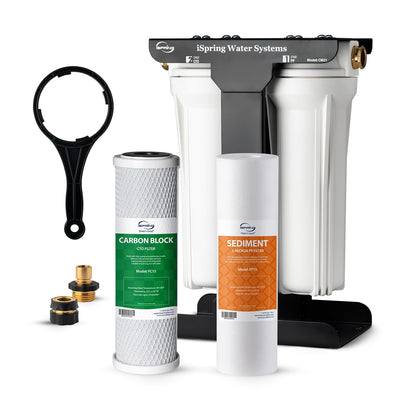
Exact product shown: iSpring CW21 2-Stage RV Water Filter System. Manufacturer photograph used with permission.
The iSpring CW21 is a two-stage RV water filter for buyers who want a serviceable sediment-and-carbon setup rather than a disposable inline cartridge. Its appeal is straightforward: the housing assembly stays in use while the filtration cartridges are replaced. Whether that is worthwhile depends on your water concerns, available storage and willingness to maintain two housings.
This guide covers the standard CW21, not the CW21-BV, CW21-PF or other specialty versions. Their similar names do not establish equivalent treatment. Our assessment is based on manufacturer documentation and practical buying considerations. We have not installed or personally tested this model, measured its pressure loss or verified current Amazon offers.
What the standard CW21 actually includes
iSpring describes the CW21 as a sediment filter followed by a CTO carbon block. The first stage addresses particulate material such as rust, dirt and sediment; the manufacturer describes a five-micron sediment stage. The second stage is intended to improve chlorine-related taste and odor. Those are distinct tasks, which is why two housings can be more useful than simply counting stages on a product box.
The listed dimensions are 11 inches long, 6 inches wide and 14.5 inches high, with a stated weight of 11.3 pounds. Treat those as manufacturer specifications, not measurements taken by RV Water Fix. Measure your actual storage compartment and allow additional working room for hoses, connectors and housing removal. A cabinet that fits the rectangular dimensions tightly may still make maintenance impractical.
Who should consider this filter?
The strongest fit is an owner using a known potable campground supply who wants separate sediment handling and carbon treatment in a replaceable-cartridge format. For a seasonal campsite or longer stays, that maintenance arrangement may be more appealing than repeatedly replacing a complete inline unit. The comparison should include the required cartridges and fittings, not just the purchase price of the frame.
For example, imagine an owner who regularly stays at one campground and notices sediment collecting in faucet screens. A dedicated sediment stage provides a specific component to inspect and replace. By contrast, a traveler moving daily may prefer equipment that packs more quickly. These are ownership tradeoffs, not evidence that either arrangement makes an unsuitable water source safe.
Know what it does not establish
The standard sediment-and-carbon description does not establish that the CW21 removes every chemical, virus or dissolved mineral. Do not borrow the claims of the BV or PF versions, or a certification associated with another iSpring system. Ask for the exact performance documentation when a particular contaminant is the reason for buying. An attractive comparison chart elsewhere on the manufacturer’s site is not a substitute for an exact-model listing.
Likewise, the word “tankless” does not turn this unit into a reverse-osmosis system. If your goal is hardness treatment, substantial dissolved-solids reduction or response to a water advisory, identify that goal separately. Our RV filtration selection guide explains how to begin with the concern instead of choosing by stage count alone.
Plan the hookup before placing an order
Trace your intended water path and identify every connected component’s operating limits. The CW21 product-page FAQ lists an operating pressure range, but that must never become a recommendation to raise the RV’s regulator above its own permitted setting. Where the equipment requirements do not overlap comfortably, ask the manufacturers for guidance before committing to the setup.
Also check the package contents and exact connection arrangement on the offer you intend to buy. Allow a route without sharp hose bends or unsupported weight at the RV inlet. Consider where the assembly will stand, how you will prevent it tipping and how you will reach the shutoff. Those practical questions matter more than an appealing photograph showing an installation on somebody else’s vehicle.
Startup and maintenance considerations
Use the current CW-series manual for assembly, cartridge orientation, flushing and inspection. Keep the supply off and relieve pressure as instructed before opening a housing. Do not use the housing wrench as permission to overtighten parts. Correct sealing surfaces, intact O-rings and the prescribed procedure matter more than additional force. If a fitting or housing is damaged, resolve that before operating the unit.
After the specified startup flushing, inspect each connection while you remain with the system. Recheck after opening and closing fixtures. Keeping a simple log of the installation date and replacement cartridge numbers makes future troubleshooting easier. If flow changes after service, you can compare the cartridge, direction and connection changes rather than guessing which part is responsible.
Replacement timing needs a record
iSpring gives different suggested replacement ranges for the sediment and carbon components, with actual timing dependent on use and source-water quality. That is a reason to keep separate records for the two stages. The sediment cartridge becoming visibly dirty does not tell you the remaining treatment capacity of the carbon cartridge, and clear-looking water does not prove either stage is still suitable.
Before buying spare filters, match the specified cartridge codes and size for the standard CW21. Do not assume that every three-filter iSpring pack is the best purchase for a two-stage system. Verify the manufacturer’s storage procedure between trips as well. Cartridges left in damp housings, exposed to freezing conditions or stored beyond the stated guidance need assessment before being returned to service.
Compare it with the CW31 and inline filters
The iSpring CW31 adds a third housing and a second carbon block in its standard arrangement. That is a concrete configuration difference, but it does not automatically make it the right upgrade for every buyer. Compare the treatment objective, documented operating conditions, space and cartridge workload before paying for another stage.
A disposable inline filter may be easier to move and store, while the CW21 provides separate replaceable stages. To compare ownership cost, list the initial equipment, compatible replacements and any additional connectors you actually need. Divide the replacement spend by your own realistic use period if a cost-per-month figure helps. Avoid using an advertised maximum capacity as a promise for every campground and season.
Questions to settle before buying
Will it fix weak shower flow?
Not necessarily. Establish whether the restriction is in the campground supply, hose, regulator, existing cartridge or one fixture. A larger-looking filter is not a pump and cannot create pressure that the source does not provide. Diagnose the supply path first and compare documented flow conditions rather than assuming two housings will improve every weak stream.
Can I use the same cartridges as a specialty CW21?
Confirm the exact approved configuration. Replacing a specialty cartridge with a standard carbon block may change the treatment claims that motivated the original purchase. Similar outer dimensions do not establish equivalent performance. Keep the system model and cartridge codes together in your maintenance folder so the next order does not depend on memory.
What is the buying verdict?
Consider the standard CW21 when its sediment-and-carbon purpose matches your known water concern and you have room to service it properly. Choose a different arrangement when your goal requires an unsupported treatment claim, the storage space is inadequate or replacement maintenance is unlikely to happen. Its value comes from a suitable, maintained installation, not from the brand name or housing count alone.
Sources and verification
Research and specifications checked November 25, 2026. Verify current model details, availability and instructions before purchase.