
RV water filter certifications help you compare documented treatment claims, but a familiar standard number is only the beginning. Check the exact model, its certified claim and the operating conditions. Do not assume every filter with similar packaging provides the same protection.
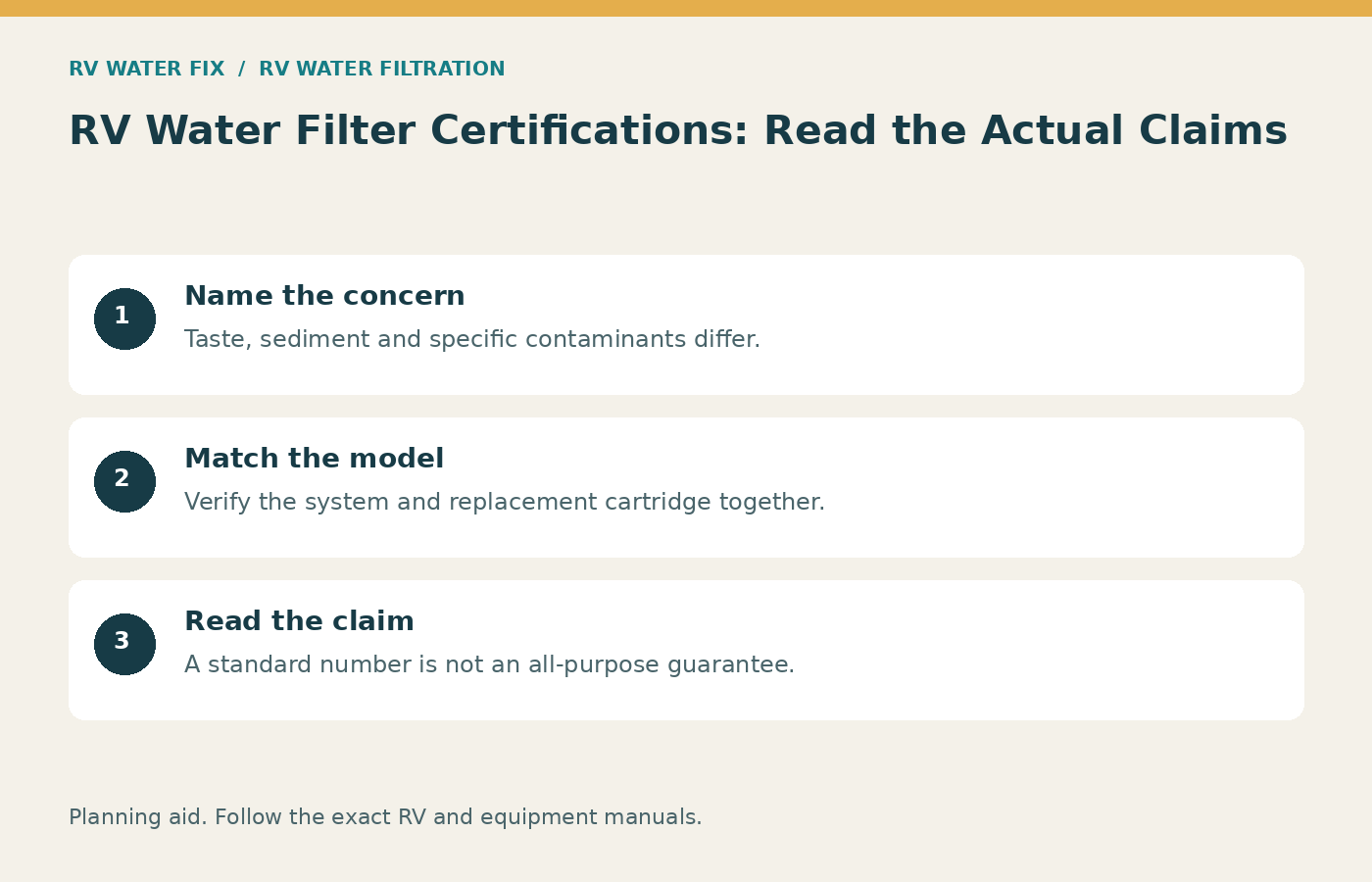
Start by naming the job. Are you trying to reduce visible sediment, improve chlorine taste or address a particular contaminant identified in a water report? Those goals call for different evidence. More stages alone do not establish broader protection.
What RV water filter certifications tell you
NSF explains that NSF/ANSI 42 covers aesthetic reductions such as chlorine taste and odor. NSF/ANSI 53 concerns specified contaminants with health effects. The numbers identify standards, not a ranking in which a higher number means a universally better filter.
The precise reduction claim matters within a standard. A certification for one contaminant does not establish reduction of every other contaminant. Similarly, a claim for a component is not automatically a certification of an entire assembled system.
Read the wording carefully. “Tested to,” “uses certified materials” and “certified by” describe different things. If a seller's badge is unclear, ask for the certifying body's listing and performance data for that model.
Match RV water filter certifications to the cartridge
Record the model number from the actual product, not just a marketplace title. Then identify its required replacement cartridge. A compatible-looking cartridge can fit physically while changing the treatment claims or service interval.
Also use the certifier's public directory where available. Check the manufacturer name, model suffix and claim. If the listing does not match, describe the claim as unverified rather than filling the gap with a similar model's documentation.
For a comparison page, keep a small evidence sheet: exact model, cartridge, claimed reduction, certifier, rated service conditions and source link. That makes future updates much easier when product listings change.
RV water filter certifications and operating limits
Look for rated flow, capacity, pressure and temperature limits in the manufacturer's performance sheet. Then ask whether those conditions match your intended RV installation. A countertop drinking-water unit and a whole-RV system have different installation demands.
Also check replacement instructions. A treatment claim is not permission to ignore service life or freeze damage. Keep a dated record of cartridge changes and storage conditions instead of relying only on how the water tastes.
CDC advises choosing treatment for the germs or chemicals of concern and warns that taste, smell and appearance do not reliably indicate safety. During a water advisory, follow the issuing authority's instructions rather than assuming an ordinary RV filter makes the water acceptable.
Compare ownership as well as treatment
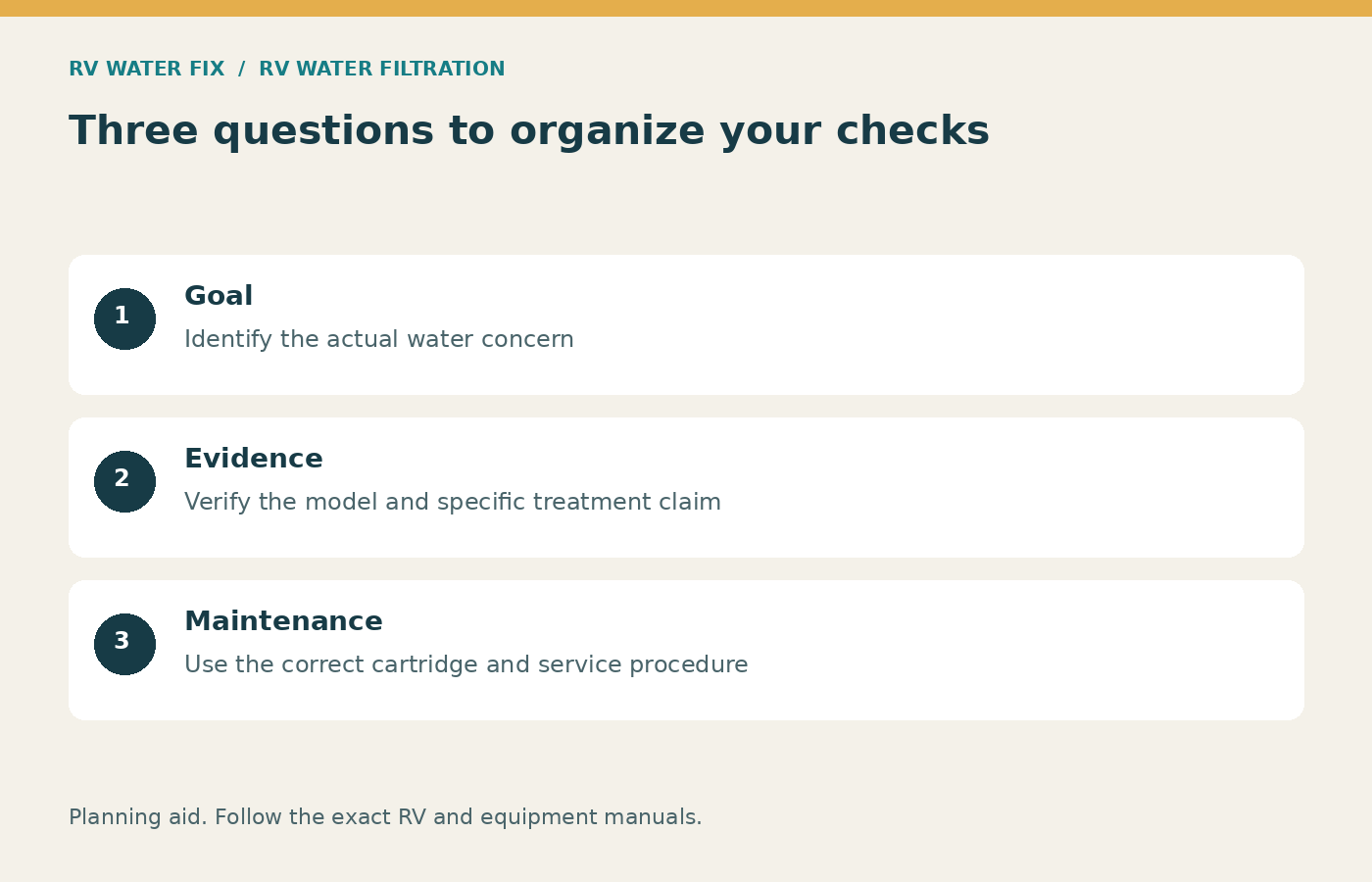
Once the evidence matches the goal, compare replacement availability, cartridge cost, setup space and hose routing. A well-documented filter that is awkward to maintain may be a poor fit for someone changing campsites every day.
For example, a weekend traveler using known potable hookups may prioritize simple installation and modest storage needs. Someone addressing a documented contaminant should first verify the exact reduction claim, then assess convenience. Neither buyer benefits from an unsupported “removes everything” promise.
Questions before you buy
Does three-stage mean safer than one-stage?
Not by itself. The media, tested claims and operating conditions determine what the system can do. Count stages only after you understand their purpose.
Is a micron number enough?
No. A pore-size statement does not describe every treatment mechanism or certify every contaminant reduction. Ask for the complete performance documentation and check whether the rating is nominal or absolute when that distinction matters.
Sources and editorial notes
Source check: November 25, 2026. This is a research-based guide, not a hands-on product test or a claim of certified technician review. Manufacturer instructions for the exact installed equipment take priority. Featured artwork is an AI-generated editorial illustration, not a product photograph or installation diagram.